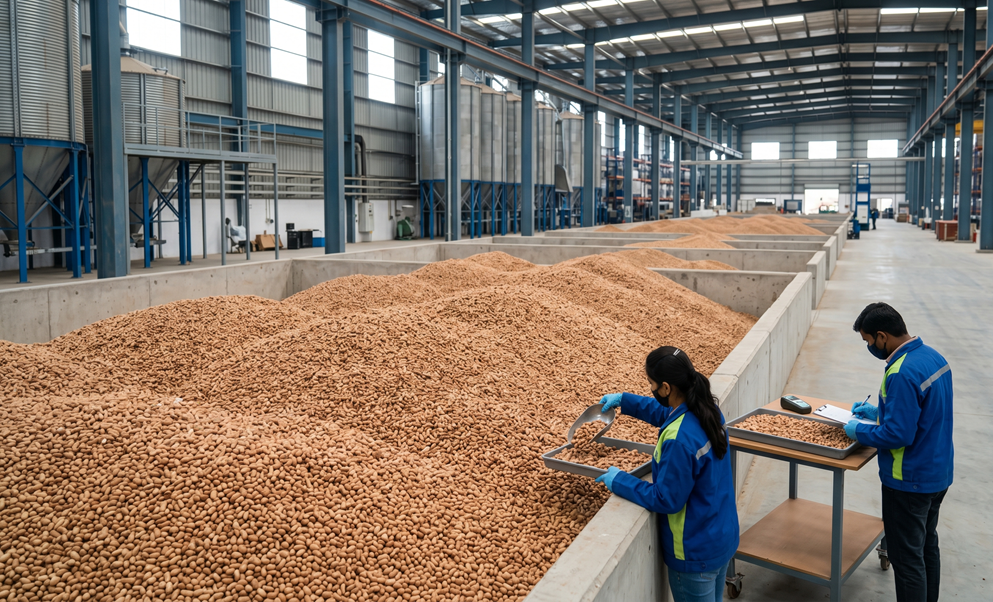
India’s peanut market is stepping into the 2026–27 agricultural season with solid production estimates and sustained global demand. With a projected increase in crop output and resilient buying interest from both the European Union and Southeast Asia, the Indian groundnut sector is firmly cementing its position as a highly competitive and reliable strategic supplier in the global supply chain.
Indian Groundnut Production Forecast
According to the latest Commodity Board market outlook published in June 2026, India’s overall groundnut production for the 2026–27 season is forecast to grow by approximately 3% year-on-year, reaching roughly 7.75 million tonnes. This anticipated growth is primarily underpinned by a 2% increase in the total planted area, which now spans 5.7 million hectares across the country. Ongoing advancements in seed technology and improved agronomic practices, specifically in major producing states like Gujarat and Rajasthan, are driving these crucial productivity gains. Furthermore, groundnut is increasingly gaining market share within India’s broader oilseed complex. It is actively replacing less profitable crops like cotton, as local farmers actively seek out commodities that offer more stable returns and diversified end-use channels ranging from direct human consumption to oil crushing.
Strong Export Demand and Price Stability
Global export demand for Indian peanuts is projected to surge by around 8% during this crop cycle. This robust international growth is largely driven by sustained buying momentum from China and steady procurement from key European re-export hubs, particularly the Netherlands, where Indian peanuts have successfully secured a stable market share due to their highly competitive pricing structure. Broad wholesale benchmarks for Indian groundnuts in early Q2 2026 are estimated in the comfortable range of EUR 1.55 to 2.05 per kg ex-warehouse. With domestic supply and international demand remaining broadly aligned, and only modest stock accumulations expected, the near-term market bias remains sideways to slightly softer in Euro terms. This outlook assumes that weather patterns, particularly the monsoon in Gujarat, remain cooperative over the coming months.
India Export Perspective
For Indian exporters like ATYA GLOBAL, the combination of higher crop availability and a slightly softer domestic price environment presents an excellent opportunity to lock in profitable long-term margins. The current pricing structure places Indian export offers at the lower-to-mid segment of the global value chain, underlining the country’s profound price competitiveness compared to Argentine and Brazilian origins. Exporters should consider leveraging pre-season contracts and systematically layering forward coverage for key product categories like Java 50-60, TJ peanuts, and blanched splits, which remain highly sought after in the European and Middle Eastern target markets.
Key Takeaway for Peanut Exporters:
Leverage the forecasted 3% crop growth and softer domestic prices to aggressively secure forward contracts with EU and Middle Eastern buyers while Indian origins remain highly price-competitive.